

Meet Khadija: Sharing Moroccan Cuisine with Travellers
In Essaouira, some of the most memorable meals are not found behind restaurant doors. They begin in a local kitchen, beside a bowl of fresh coriander, a collection of well-used spice jars and a host who understands that cooking is as much about human connection as it is about recipes.
For the travellers who join her at Essaouira Cooking, that host is Khadija.
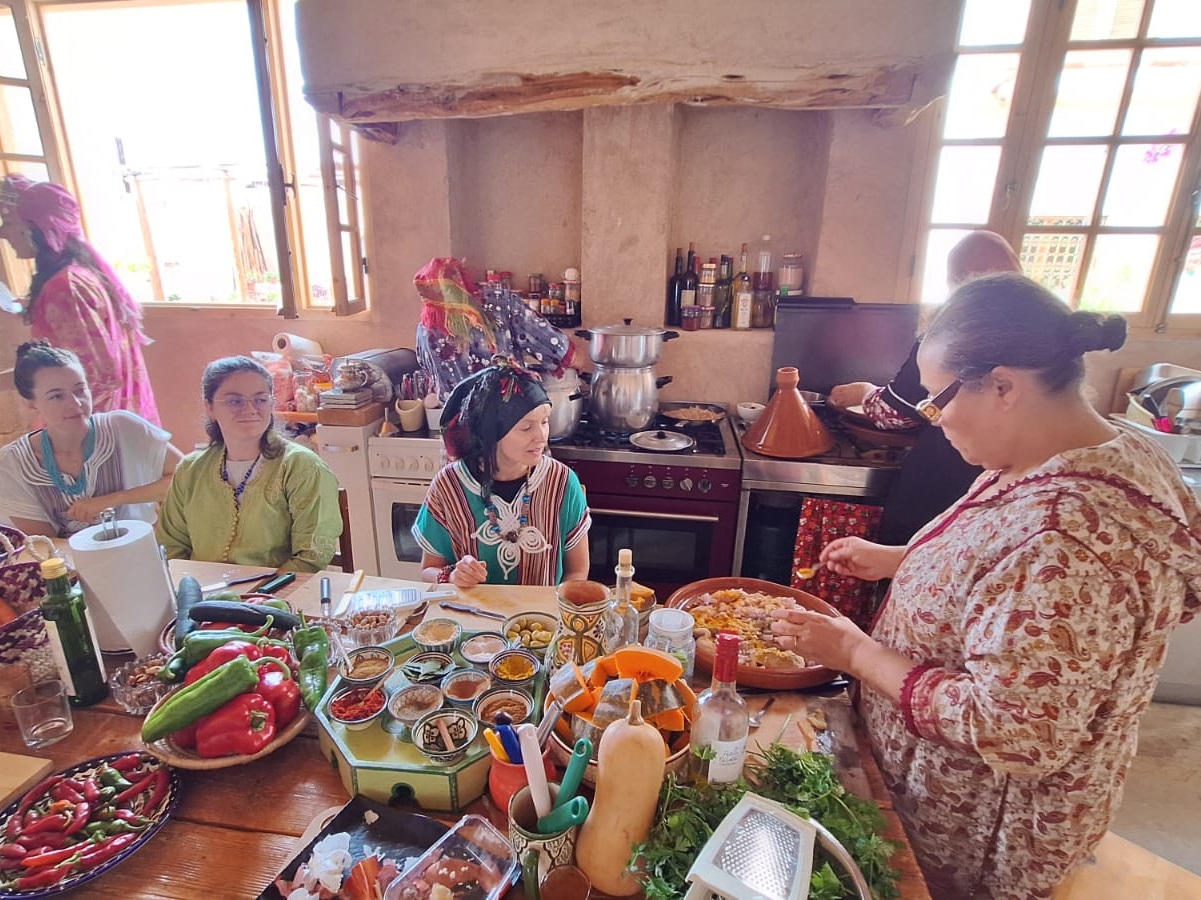
Warm, attentive and deeply attached to Morocco’s culinary traditions, Khadija welcomes visitors into a world shaped by family recipes, local ingredients and the pleasure of preparing food together. Her cooking classes are not demonstrations watched from a distance. They are shared experiences in which guests chop, season, knead, taste and gradually discover the gestures behind Moroccan home cooking.
Around the table, cultural differences begin to fade. People who arrived as visitors leave carrying recipes, new skills and the memory of a meal prepared in good company.
A Kitchen Rooted in Everyday Morocco
Moroccan cuisine is often presented through its most celebrated dishes: couscous, tagine, pastilla and mint tea. Yet its real character lies in the details—the way herbs are chopped, spices balanced, vegetables arranged and sauces allowed to develop slowly.
These are precisely the details Khadija shares.
Her approach reflects the logic of Moroccan family cooking: work with fresh ingredients, respect the season and give each preparation the time it needs. A recipe is not reduced to a rigid sequence of instructions. It is understood through touch, aroma, colour and experience.
Guests learn that cumin should support a dish rather than overwhelm it, that preserved lemon brings both saltiness and fragrance, and that a tagine is shaped as much by patience as by its ingredients.
Khadija explains these principles in an accessible way. She does not expect visitors to arrive with technical knowledge. Questions are encouraged, unfamiliar ingredients are introduced without ceremony, and every stage becomes an opportunity to understand why Moroccan cooks do things in a particular way.
The result is a class that feels relaxed while remaining genuinely instructive.
More Than Following a Recipe
A recipe can list quantities and cooking times. It cannot fully communicate the texture of properly prepared couscous, the consistency of a tagine sauce or the moment when a mixture of onion, herbs and spices has cooked long enough.
Those things are learned by watching, touching and tasting.
Khadija’s role is therefore not simply to provide instructions. She helps participants recognise the signals that guide an experienced cook.
How finely should parsley and coriander be chopped? How much water does a particular semolina need? When should the heat be lowered? How can a recipe be adapted when one ingredient is unavailable at home?
These practical questions matter because most travellers want to recreate the dishes after leaving Morocco. Khadija’s teaching gives them more than a souvenir recipe: it gives them the confidence to cook independently.
She also makes Moroccan cuisine feel approachable. The elegant presentation of a finished tagine may suggest complexity, but its preparation is built from techniques that can be understood and repeated. Under her guidance, guests see how individual steps come together and how a small number of well-chosen ingredients can produce remarkable depth of flavour.
Cooking as a Form of Hospitality
Hospitality occupies a central place in Moroccan culture. It can be expressed through a glass of tea, bread shared at the table or a dish prepared with particular care for a guest.
In Khadija’s kitchen, hospitality is never reduced to polished service. It is personal and participatory.
Visitors are invited to become part of the preparation rather than remain spectators. Conversation moves naturally between ingredients, travel, family traditions and everyday life in Essaouira. The atmosphere is informal enough for people to relax, but attentive enough for everyone to remain involved.
The rhythm is different from that of a restaurant. There is no need to hurry from one course to the next. Time is allowed for questions, explanations and the small conversations that arise while vegetables are being cut or dough is being kneaded.
This slower rhythm creates space for genuine encounters.
Travellers may arrive from different countries and speak different languages, yet preparing food gives the group an immediate common purpose. Someone measures the spices, another shapes the bread, while someone else watches over the tagine. By the time the meal is served, the participants have already created something together.
From Essaouira’s Markets to the Table
Essaouira gives Khadija’s cooking its particular setting. The city is connected to the Atlantic, to the surrounding farmland and to the argan-growing countryside of southwestern Morocco.
Its markets provide vegetables, fruit, fresh herbs, olives, preserved lemons, pulses and spices. The fishing port brings another culinary dimension, with sardines and other Atlantic fish forming part of the city’s food identity.
Whenever a culinary experience includes a market visit, the class begins before anyone enters the kitchen. Participants discover how ingredients are selected, what is seasonal and how local shoppers assess freshness and quality.
A bunch of coriander is no longer simply a line in a recipe. It has been chosen from a market stall. A fish tagine begins with understanding the day’s catch. Culinary argan oil becomes connected to the landscape and to the work required to produce it.
Khadija helps guests make these connections between place, product and preparation. This local context transforms the cooking class into a broader introduction to Essaouira’s food culture.
Recipes Carried Through Families
Much of Morocco’s culinary knowledge has traditionally been transmitted within families. Techniques are demonstrated, repeated and gradually mastered. Precise measurements may be less important than observing the experienced cook standing beside you.
Khadija belongs to this culture of practical transmission.
The dishes she teaches are not treated as museum pieces. They are living recipes that continue to be cooked, shared and adapted. Their value comes from repetition and from the memories attached to them.
This does not mean that every Moroccan family prepares a dish in exactly the same way. On the contrary, recipes often vary from one household or region to another. One cook may favour a particular spice, while another adjusts the herbs, vegetables or level of sweetness.
Khadija helps visitors understand this flexibility. Moroccan cuisine has principles and traditions, but it is not frozen. A recipe survives because people continue to make it their own while respecting its essential character.
For travellers, this is a liberating lesson. Recreating a dish at home does not require reproducing every condition perfectly. What matters is understanding the balance of flavours and the purpose of each stage.
Small Groups, Real Conversations
The intimate nature of Khadija’s workshops is one of their strengths. In a small group, every participant can see the preparation closely, ask questions and take an active role.
It also allows Khadija to adapt her explanations. An experienced cook may want to discuss technique, while a beginner may need reassurance with basic preparation. Vegetarian guests or participants with dietary requirements can better understand which ingredients may be adjusted and which are central to the dish.
Small groups also preserve the human dimension of the experience. Names are remembered, conversations continue across the table, and the meal retains the feeling of a gathering rather than becoming an anonymous activity.
For solo travellers, couples, families and friends, this atmosphere can offer something increasingly valuable: meaningful contact with a local host rather than a standardised tourist performance.
The Ritual of Moroccan Mint Tea
Few gestures express Moroccan welcome as clearly as preparing mint tea.
The familiar combination of green tea, fresh mint and sugar may appear simple, but the service has its own rhythm and etiquette. The tea is brewed, mixed and poured with care, often from a height that aerates the drink and creates a delicate layer of foam.
With Khadija, tea is not merely an additional item on the menu. It belongs to the social life surrounding the meal. It welcomes guests, accompanies conversation and provides a moment to pause.
Learning to prepare Moroccan tea gives visitors a ritual they can easily repeat at home. Long after the more elaborate dishes have been eaten, the scent of mint can bring back the memory of Essaouira and the people with whom the tea was shared.
Sitting Down to the Meal
The final stage of the class is also the most satisfying: everyone sits down to eat what they have prepared.
At this point, the dishes carry the history of the afternoon. Participants remember who chopped the herbs, who prepared the vegetables and how the aromas changed as the meal cooked.
Eating together completes the experience. Moroccan food is designed for sharing, and its meaning is inseparable from the table around which it is served. Bread passes from hand to hand, the lid of the tagine is lifted and the group discovers the result of its collective work.
The meal is celebratory, but it is also reflective. Visitors can now identify the ingredients and techniques they encountered earlier. Flavours that might once have seemed mysterious have become understandable.
That transition—from tasting a cuisine to beginning to comprehend it—is at the heart of Khadija’s workshops.
What Travellers Take Home
The practical souvenirs of a cooking class are easy to describe: recipes, techniques and a better understanding of Moroccan ingredients.
The less tangible ones are often more lasting.
Travellers leave with a memory of being welcomed, of conversations held around a kitchen table and of discovering a city through the person preparing its food. They may remember Khadija correcting a gesture, explaining a spice or encouraging them to trust what they could smell and see.
These details give the experience its emotional depth.
Culinary tourism is at its most meaningful when it does not turn local culture into a performance. Khadija’s approach works because the encounter remains grounded in real cooking, generous hospitality and an honest desire to transmit knowledge.
The food is important, but it is also the beginning of something larger.
Meeting Essaouira Through Khadija
A city can be explored through its monuments, streets and landscapes. It can also be understood through the people who live there and the knowledge they choose to share.
Through Khadija, travellers encounter an Essaouira shaped by market ingredients, Atlantic influences, family traditions and meals prepared without haste. They discover that Moroccan cuisine is not only a collection of famous dishes, but a language of welcome and connection.
Her classes offer an invitation to participate in that language.
Guests arrive ready to learn how to prepare a tagine, couscous, pastilla, Moroccan bread or another local speciality. They leave with something more personal: the feeling that, for a few hours, they were not simply visiting Essaouira.
They were welcomed to its table.