

Inside an Argan Oil Cooperative Near Essaouira
A short drive beyond Essaouira, the city’s white ramparts and Atlantic horizon give way to a drier, quieter landscape. Low hills rise behind scattered villages, stone walls divide small plots of land and argan trees stretch their thorny branches towards the Moroccan sun.
At first glance, these trees appear modest. Their trunks twist irregularly, their leaves are small and their fruit resembles neither the olive nor the almond with which argan oil is sometimes compared. Yet this resilient tree lies at the heart of one of southwestern Morocco’s most distinctive culinary traditions.
Inside a local cooperative, the familiar bottles displayed in medina shops acquire a different meaning. Argan oil is no longer simply a golden product associated with cosmetics or fashionable restaurants. It becomes the result of a landscape, an inherited body of knowledge and a long sequence of work traditionally carried out by Amazigh women.
Visiting a cooperative near Essaouira reveals just how much labour is contained in every bottle.
The Argan Tree and Its Landscape
The argan tree, Argania spinosa, grows naturally in southwestern Morocco. Its principal territory extends through the regions surrounding Essaouira, Agadir and the Souss Valley, forming a distinctive ecosystem known as the arganeraie.
This is an environment shaped by limited rainfall, strong sunlight and periods of drought. The argan tree has adapted to these conditions through deep roots and a remarkable capacity to survive in dry soil.
Its importance extends far beyond oil production. Argan trees contribute to stabilising the soil, limiting erosion and supporting rural life. Their branches provide shade, their fruit supplies kernels for oil, and the surrounding landscape offers grazing and other agricultural resources when carefully managed.
For local communities, the argan tree is therefore not simply a crop. It belongs to a broader relationship between people, livestock, land and seasonal cycles.
The practices and knowledge connected with the tree were inscribed by UNESCO on the Representative List of the Intangible Cultural Heritage of Humanity in 2014. This recognition concerns not only the finished oil but also the methods, social customs and knowledge transmitted between generations.
Entering the Cooperative
The atmosphere inside an argan cooperative is different from that of a conventional factory.
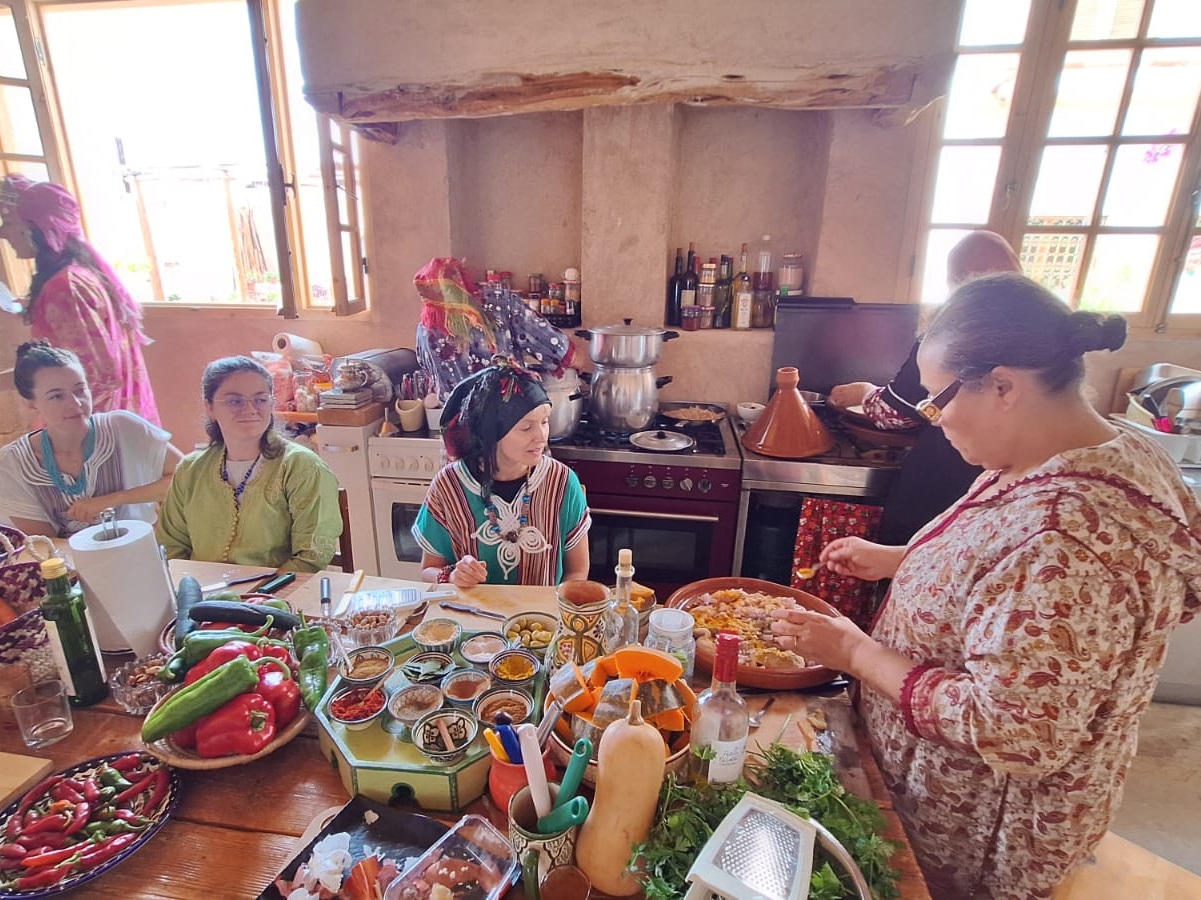
In some establishments, part of the process remains manual. Women sit together around low tables or on woven mats, working through baskets of dried fruit and hard argan nuts. Conversation accompanies the repeated sound of stone against shell.
Other stages may use modern equipment for pressing, filtering, bottling or quality control. The balance between traditional work and mechanisation varies from one cooperative to another.
Visitors are often shown the production process step by step. The demonstration may initially appear simple: open the fruit, break the nut, remove the kernel and extract the oil. In practice, each stage requires time, dexterity and careful selection.
The cooperative model can also bring production, administration, packaging and sales together under one organisation. Where it functions transparently, it can help members retain a greater share of the value created by their work.
However, the word “cooperative” should not be treated as an automatic guarantee. Organisations differ in their structure, working conditions, sourcing and distribution of income. A responsible visitor should remain curious about how a particular cooperative actually operates.
From Fruit to Kernel
Argan fruit is collected after it ripens and falls from the tree. Harvesting practices and access to the trees are governed by local customs, land-use arrangements and seasonal conditions.
The fruit must first be dried. Its fleshy outer pulp is then removed, revealing a very hard nut. This stage is sometimes known as depulping.
The dried pulp is not necessarily discarded. In rural agricultural systems, parts of the fruit may be used as animal feed or incorporated into other household activities.
Inside the nut are one or more small kernels containing the oil. Reaching them is one of the most demanding stages of production.
The Skill of Cracking Argan Nuts
Argan shells are exceptionally hard. They are traditionally opened by placing the nut on a flat stone and striking it with a smaller handheld stone.
The movement appears effortless when performed by someone experienced. One precise blow cracks the shell without crushing the kernels inside. For an untrained visitor, achieving the same result can prove surprisingly difficult.
Too little force leaves the nut intact. Too much damages the kernels. The hand must also remain steady and safely positioned away from the striking stone.
This skill illustrates something easily overlooked in commercial descriptions of argan oil: knowledge resides in the body as well as in written instructions. It is learned through observation and repetition, often passed from mothers to daughters and shared among women working together.
A basket of intact nuts may represent many hours of concentrated labour before a sufficient quantity of kernels is obtained.
Selecting and Preparing the Kernels
Once removed, the kernels are inspected. Damaged or unsuitable pieces must be separated from those used to make good-quality oil.
At this point, production divides according to the intended use of the finished product.
For culinary argan oil, the kernels are lightly roasted. Roasting develops the oil’s characteristic toasted aroma and deep, nutty flavour. The degree of roasting influences its colour and taste: insufficient roasting may produce a mild oil, while excessive heat can introduce bitterness or burnt notes.
For cosmetic argan oil, the kernels are not roasted. This produces an oil with a much lighter aroma intended for external use on skin or hair.
The difference is fundamental. Visitors should never assume that every bottle of argan oil is interchangeable. A product intended for cosmetic use is not automatically sold as food-grade, while roasted culinary oil is chosen specifically for its flavour.
Grinding and Pressing
Traditionally, roasted kernels were ground into a thick paste using a stone hand mill. Water was then incorporated while the paste was kneaded, allowing the oil to separate gradually.
This ancestral method is labour-intensive and produces an oil with a relatively short storage life because of the added water.
Many cooperatives now combine traditional kernel preparation with mechanical cold pressing. The kernels pass through a press that separates the oil from a dense residue sometimes called press cake.
Mechanical extraction offers greater consistency and hygiene while reducing the need to add water. The oil can then be allowed to settle or be filtered before bottling.
Modern equipment does not necessarily erase traditional knowledge. The quality of the final product still depends on harvesting, storage, kernel selection, roasting and careful handling. Machinery changes part of the extraction process, but it does not replace the judgement required throughout production.
The First Taste
Culinary argan oil has a flavour unlike that of olive oil.
Its aroma is warm and toasted, with notes that may recall roasted hazelnuts, sesame or lightly browned bread. On the palate, a good oil feels rich without being heavy and finishes with a distinct nuttiness.
It is generally appreciated raw or added near the end of preparation, where its flavour remains noticeable. Heating it aggressively would diminish the qualities that make it special.
At a cooperative tasting, the oil may be served simply with Moroccan bread. This is often the best introduction: no competing flavours, just the oil’s colour, aroma and texture.
It may also be presented alongside honey or incorporated into amlou, one of the region’s most beloved preparations.
Amlou: The Taste of the Argan Country
Amlou is sometimes described as Moroccan peanut butter, but this comparison fails to capture its flavour or cultural setting.
Traditional amlou combines roasted almonds, culinary argan oil and honey. The almonds provide body, the honey adds sweetness and the oil gives the mixture its unmistakable toasted character.
Its texture can range from fluid and glossy to thick and rustic, depending on the proportions and how finely the almonds are ground. It is usually eaten with bread, msemen or harcha, particularly at breakfast or during afternoon tea.
Because almonds and genuine argan oil are relatively valuable ingredients, less expensive commercial versions may use peanuts, vegetable oil or additional sweeteners. Such spreads may still be enjoyable, but they should not be presented as traditional almond amlou without clear labelling.
At a transparent cooperative, visitors should be able to ask exactly what the jar contains.
Women, Work and Economic Independence
The international success of argan oil has transformed a regional product into a valuable commodity. It has also created economic opportunities for rural women whose knowledge has long sustained its production.
Women’s cooperatives may provide paid work, professional training, literacy programmes, social support and greater participation in financial decisions. For some members, income from argan production can contribute to household expenses, children’s education or personal independence.
These benefits should not be romanticised. Nut cracking remains demanding work, and the global retail price of argan products does not automatically reflect what individual producers earn.
A cooperative is most meaningful when its members participate in its governance, understand how products are priced and share fairly in the income generated by sales.
Visitors can ask straightforward questions:
-
How many women are members of the cooperative?
-
Are they cooperative members or occasional workers?
-
Which production stages take place on site?
-
Where is the fruit sourced?
-
How are members paid?
-
Does the cooperative provide training or other services?
-
Are its accounts, certifications or production standards available for consultation?
A genuine organisation should not be offended by respectful interest in how it functions.
Tradition and Modern Quality Standards
The image of women cracking nuts by hand has become closely associated with argan oil marketing. It represents a real and important skill, but it is only one part of responsible production.
Quality also depends on cleanliness, traceability, appropriate storage and protection from oxidation. Kernels that have been poorly stored can produce oil with unpleasant flavours or reduced stability. Exposure to air, light and heat can damage the finished product.
Professional cooperatives may therefore use stainless-steel presses, filtration systems, batch records and laboratory testing alongside manual preparation.
This combination of inherited knowledge and modern quality control is not a contradiction. It can protect both the product and the reputation of the women who produce it.
The most convincing visit is one where the demonstration corresponds to an actual production chain rather than functioning only as a performance for tourists.
How to Recognise Culinary Argan Oil
Good culinary argan oil should clearly state that it is intended for food use. Its label should identify the producer or cooperative, provide a quantity and preferably include a batch reference, production or best-before date and storage guidance.
The oil commonly has a golden to amber-brown colour, depending on the roasting and filtration. Colour alone, however, cannot prove authenticity.
Its aroma should be distinctly toasted and nutty without smelling rancid, burnt or artificially perfumed.
Before purchasing, consider the following:
-
Is the bottle properly sealed?
-
Is the producer clearly identified?
-
Is it labelled as culinary or food-grade argan oil?
-
Are the kernels roasted?
-
Does the seller explain where production takes place?
-
Is there a batch or traceability reference?
-
Is the oil protected from excessive light and heat?
-
Can you taste it before buying?
Packaging in a dark bottle can help protect the oil from light, although a clear bottle placed inside a protective box may serve a similar purpose.
Suspiciously low prices deserve caution. Producing genuine argan oil requires a substantial quantity of fruit, considerable labour and careful processing.
Culinary Oil and Cosmetic Oil
The distinction between culinary and cosmetic oil should be made explicit during any cooperative visit.
Culinary argan oil
-
produced from roasted kernels;
-
has a pronounced toasted aroma;
-
used with bread, couscous, salads and other dishes;
-
forms a central ingredient in traditional amlou;
-
must be labelled and handled as a food product.
Cosmetic argan oil
-
normally produced from unroasted kernels;
-
has a milder natural aroma;
-
intended for use on the skin, hair or nails;
-
should be sold with suitable cosmetic labelling and hygiene controls.
Some sellers claim that one unlabelled bottle can be used for everything. A more reliable producer will distinguish the two processes and explain the intended use of each product.
Beyond the Oil
Argan cooperatives increasingly transform the tree’s products into a wider range of goods.
Depending on the establishment, visitors may find amlou, soaps, creams, shampoos, balms and cosmetic blends. Some cooperatives also sell honey, almonds, herbs or other products supplied by nearby rural producers.
This diversification can create additional sources of income, but it also makes transparent labelling more important. A product that contains argan oil is not the same as pure argan oil.
Read the ingredient list. Ask whether perfumes, preservatives, other oils or sweeteners have been added. Avoid attributing medical benefits to a product solely because it contains argan.
The most credible producers describe what they make accurately without promising miraculous results.
Visiting Without Turning Work into a Spectacle
A cooperative visit should be approached as an encounter with a workplace and a body of cultural knowledge, not simply as a shopping stop.
Ask before photographing the women, particularly when taking close portraits. A group that receives visitors regularly may permit photography in designated areas, but consent should never be assumed.
Listen to the explanation before moving towards the shelves. Try the oil slowly and compare culinary and cosmetic products without treating the tasting as an obligation to buy.
If you do make a purchase, select products you genuinely intend to use. Buying directly from a well-run cooperative can keep more value within the producing community, but thoughtful purchasing is more useful than accumulating decorative bottles.
It is also reasonable to leave without buying when the organisation cannot clearly answer basic questions about production or membership.
The Challenges Facing the Arganeraie
The argan landscape is resilient, but it is not invulnerable.
Climate change, prolonged drought, pressure from grazing, intensive resource use and changes in rural economies can all affect the regeneration of argan forests. Increasing global demand may create economic incentives to protect the trees, but it can also place greater pressure on the resource when production is poorly managed.
Sustainable argan production therefore depends on more than selling oil. Young trees must be protected, local land-use practices respected and communities given a genuine economic interest in maintaining the forest.
The future of argan oil is inseparable from the future of the landscape that produces it.
A responsible cooperative should be able to discuss sourcing and environmental stewardship, even if it does not manage every stage of forest conservation itself.
What a Cooperative Visit Adds to a Stay in Essaouira
Essaouira’s medina contains countless bottles labelled “argan oil”. Without context, it is difficult to understand why prices vary or what distinguishes one product from another.
A visit to a cooperative changes that.
Seeing the dried fruit, holding the hard nut and watching a kernel being extracted makes the production process tangible. The repeated movement of stone against shell explains why authentic oil cannot be treated as an inexpensive industrial commodity.
Tasting the oil where it is produced also connects flavour to place. Its toasted character evokes the dry hills, the rural villages and the culinary traditions of the region beyond Essaouira’s walls.
Most importantly, visitors encounter the people whose work and knowledge stand behind the product.
From the Argan Tree to the Moroccan Table
Argan oil is often marketed internationally as a luxury beauty ingredient. Near Essaouira, it belongs to a much older and broader story.
It is poured into a dish for dipping bread, blended with almonds and honey, offered to guests and shared at family tables. Its production carries knowledge passed through generations of Amazigh women. Its value is connected to rural livelihoods and to one of Morocco’s most distinctive landscapes.
Inside a cooperative, every stage reveals another layer of that story: the fruit gathered from the tree, the shell opened by hand, the kernel carefully roasted and the first fragrant drops emerging from the press.
The finished oil may fit inside a small bottle. The world it represents is far larger.